Shah-Makers
Did Israel Manufacture a ‘National Demand’ to Legitimize Military Attack on Iran?
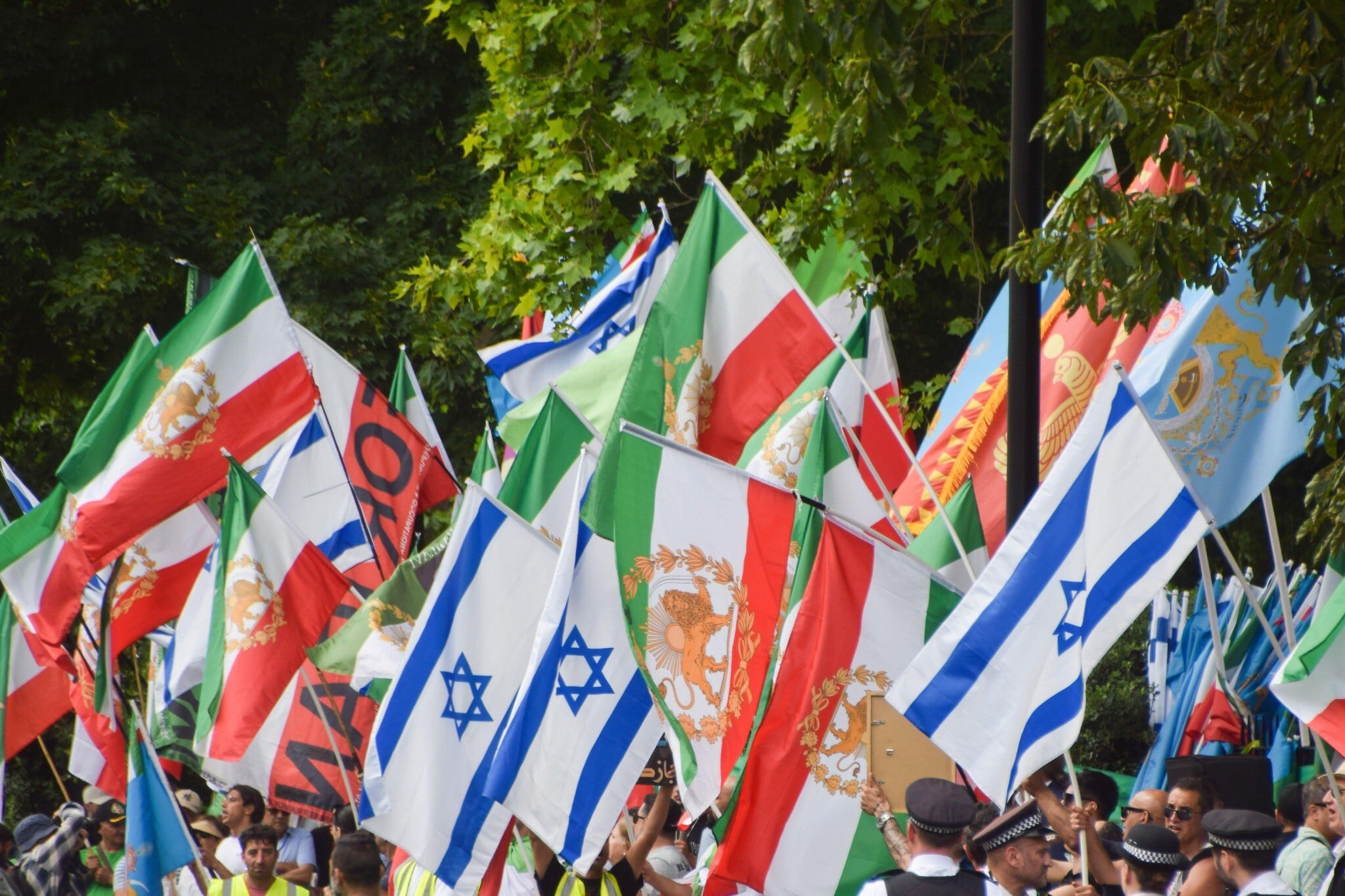
The Project
The evidence indicates that Israel, either directly or through networks of intermediaries and media-digital contractors, has directed and supported a multilayered Persian-language influence campaign whose aim was to elevate Reza Pahlavi as the principal option after the Islamic Republic. This campaign was not limited merely to creating a few fake accounts or “buying” a television channel. Rather, it involved a complete, coordinated ecosystem composed of diverse tools, media outlets, and actors: a network of inauthentic accounts with fabricated identities, often using images generated by artificial intelligence; Persian-language media based outside the country; algorithmic amplifiers on social networks; and the continuous production of content intended to steer public opinion. Within the framework of this project, hashtags, videos, breaking-news items, and even emotional narratives about violent events were designed and disseminated in such a way as to reproduce and reinforce, continuously, a specific political line: a focus on Reza Pahlavi’s leadership as the most effective, the most credible, the most meaningful, and ultimately the only alternative to the Islamic Republic.
This network has operated coherently not only in producing content, but also in timing and synchronizing narratives. In moments of crisis, from street protests to periods of military attacks on the country, suitable content was rapidly produced and distributed in order to shape the dominant narrative and, more importantly, give it depth and consistency. For example, exaggerated or unverified reports about mass casualties were circulated, or responsibility for violent incidents was redefined in ways that would direct public emotions, especially public anger, in a particular direction. This pattern shows that the goal was not merely informing the public, or even propaganda, but the real-time “engineering of collective perception” and the creation among Iranians of a sense of urgency, crisis, and need for a “final and immediate solution” - a solution that, in the dominant narrative, was tied to regime change, Pahlavi’s role, and ultimately military attack.
Yet the real significance of this operation was not confined to a project aimed at supporting and bringing to victory one particular political figure. What distinguishes this project and its success is its effort, and success, in constructing a space, or a broad “perceptual paradigm,” within which it appears obvious to the inhabitants of that space that a widespread, spontaneous, internal movement among Iranians - not merely a segment of the opposition or diaspora - is demanding not only a transition from the Islamic Republic to some form of democracy, but also a transition from a republican system to monarchy, and ultimately even the achievement of that goal at the price of foreign military intervention. It was within such a framework that the “perceptual majority” desired by Israel successfully took shape: a situation in which, through the coordination of techniques such as repetition, simultaneity, and algorithmic amplification, a very specific viewpoint is represented and “made real” as the dominant voice of society, not only for others but even for the society itself, even if numerically and quantitatively that viewpoint does not in reality belong to the majority in that society.
In this context, the elevation of Reza Pahlavi as “the voice of this demand” naturally played a central role. He was presented not only as a political figure and as a “symbol,” but also as an intermediary between this “perceptual demand” and external actors: someone who could “represent” or “take mandate for” this desire, translate it into the language of international politics, and convey it to the ears of global power-holders. In other words, the influence operation was not only about constructing a figure; it required the creation of a complete semantic and perceptual chain: from the production of dissatisfaction and anger, to the representation of that dissatisfaction as a public demand that had in practice reached an impasse and remained deeply unanswered, and finally to the elevation of a specific political alternative as the only imaginable response to it. It should not go unmentioned that the Islamic Republic, especially under the leadership of Ali Khamenei, had created an exceptionally suitable platform for advancing these steps, owing to an inflexibility that appears to have reflected, to a very large extent, Khamenei’s own personality and mode of thought more than the political system of the Islamic Republic itself. It was a platform on which the steps of producing widespread dissatisfaction and anger, together with absolutist repression and the resulting public frustration, were voluntarily, repeatedly, and abundantly taken by the Islamic Republic itself on Israel’s behalf.
Internal Factors
Although this analysis focuses on a specific influence operation, ignoring the role of the Islamic Republic itself in preparing the ground for this project can lead to an incomplete, and even misleading, picture of reality. The reality is that over the past four decades, and especially over the past two, the political structure ruling Iran has turned from an ideological system with limited capacity for reform into a deeply closed, repressive system incapable of responding to social demands. The leadership of Ali Khamenei has played a decisive role in this process; under this approach, every critical voice, even from within the system itself, has been interpreted as a threat, and one path of political dialogue after another has been closed. The gradual exclusion of reformists, sweeping disqualifications, election engineering, and violent suppression of social movements from the Green Movement to the “Woman, Life, Freedom” uprising all clearly indicate a system that, instead of managing dissatisfaction, can imagine only “repression” and the silencing of that dissatisfaction - to the point that every grievance is ultimately and inevitably driven toward an explosive point.
These basic features have caused the Islamic Republic itself to become the most active producer of the raw materials needed by foreign influence operations. Every image of street repression, every rushed death sentence, every arbitrary arrest, and every contemptuous remark by officials toward people’s demands naturally becomes content that influence networks do not need to create from scratch; they need only amplify it, recirculate it, and place it within a particular narrative frame. In other words, the short-sighted mentality and inflexibility of the upper layers of power in Tehran - at times so intense that even the regime’s own strategic interests are ignored - has created a kind of “unintended synergy” with external projects. Under such conditions, part of the success of influence operations stems not from the ingenuity of their designers, but from the generosity of a government that repeatedly and in large quantities provides the fuel needed to keep the opposition’s narrative-making machine turning.
In addition to the Islamic Republic’s intrinsic inability, as a project founded by Khomeini, to manage the voice of opposition or even dissatisfaction - or indeed because of that inability - the deep reality of “nostalgia” that has emerged from the depths of Iranian society in recent years has also been one of the self-generated foundations for Israel’s project. This nostalgia can perhaps be divided into two categories: Pahlavi nostalgia and Achaemenid nostalgia. The real and natural nostalgia that has grown in a large part of Iranian society over the past decade or two with respect to the Pahlavi era may be reflected in exaggerated form in media narratives, but it also has real roots in the lived experience of generations who either remember the pre-revolutionary period themselves or imagine it through family and intergenerational memories. The image reproduced in this nostalgia is often a combination of relative economic stability, cultural openness, healthy and extensive international relations, and a sense of progress and social modernity, which is quickly placed in stark contrast with the bitter experience of the post-revolutionary decades - war, sanctions, international isolation, repression and social and personal restrictions, poverty, corruption, and numerous economic difficulties. Such a comparison, even if not fully accurate historically and even if it overlooks many structural problems of the Pahlavi era, remains a real and undeniable socio-psychological phenomenon.
Beyond Pahlavi nostalgia, there is also a deeper symbolic attraction in the minds of some Iranians that goes back to Iran’s several-thousand-year imperial history. The grandeur of the Achaemenids, the Sasanian legacy, and the mythic image of kings such as Cyrus have been inscribed in Iran’s collective memory as symbols of national and civilizational greatness. In circumstances where the current regime either ignores parts of this legacy or stands in tension with it, this symbolic treasury naturally becomes a capital resource for the monarchist current. In other words, part of the reception given to Reza Pahlavi is not necessarily the product of an influence operation, but rather reflects an emotional and identity-based connection with a historical narrative of Iran. This reality in no way contradicts the preceding analysis; on the contrary, it is precisely this real background that allows a perceptually engineered operation to ride upon a pre-prepared substrate and amplify and magnify it disproportionately. The distinction between “authentic nostalgia” and “artificial magnification” is exactly where the analyst must pause carefully, because conflating the two - whether by supporters or critics - leads to a mistaken understanding of social reality.
Method
Although this operation drew heavily on the classic model of “astroturfing” - the artificial manufacture of popular support - it did so in a far more complex and updated form, relying on tools such as artificial intelligence, coordinated networks of fake accounts, and centralized management of narrative in digital space. The accounts were created in advance and activated simultaneously at sensitive moments. They produced content in vernacular Persian and tried to pass themselves off as ordinary Iranian users and protesters. This structure allowed them not only to amplify messages, but also to simulate the perceptual space of a “spontaneous consensus.”
The tactics employed were designed with considerable sophistication and covered a wide range of methods: coordinated amplification of hashtags and messages that appeared to be published by accounts from inside Iran; fake or manipulated news and videos; and, most importantly, the construction of immediate narratives in moments of crisis. For example, during the attack on Evin Prison, fabricated content was rapidly disseminated, was given weight by aligned media such as Iran International, and was then accompanied by calls for street action. This clearly indicates that the goal was not merely to inform, but to direct collective behavior live and in real time.
Similar patterns were observable in other cases as well: the incorrect attribution of violent events to the Iranian government, or the severe exaggeration of casualties in ways that intensified the sense of urgency and public anger. For example, in early 2026, some Persian-language media outside the country, following Iran International, published reports claiming that tens of thousands of protesters had been killed in a short period. These reports were quickly recirculated on social media and produced a “hyper-inflamed” psychological atmosphere. In reality, however, there was no data or evidence capable of confirming such extraordinary figures, and Iran International never provided a source or sources for them. Or, for instance, after the bombing of a primary school in Minab by American forces, some aligned media outlets and networks explicitly tried to attribute responsibility for the attack to the Iranian government itself. This was a narrative that spread widely online in the first hours, and even weeks after the Pentagon’s own initial assessment concluded that U.S. forces were likely responsible for the strike on the school in Minab, the accusation against the Iranian government continued to be used by associated accounts.
At the same time, these activities were coordinated with Israel’s official messages as well. In his public messages, Benjamin Netanyahu repeatedly called on the people of Iran to act and asked them to “take their fate into their own hands.” This simultaneity of course reflects a deeper connection between military operations and psychological operations: military attacks functioned as “trigger events,” while media and digital networks attempted to steer those events toward particular protest currents and political perceptions. Overall, the project can be understood as an example of a hybrid operation in which hard war and soft war were skillfully employed simultaneously and as complements to one another.
To periodize this project, one can distinguish between its overt political emergence and the construction of its hidden operational infrastructure. The first identifiable stage goes back to late 2022 through January 2023, coinciding with the “Woman, Life, Freedom” uprising, when Reza Pahlavi introduced the “I give my mandate” campaign. This moment marked a transition from mere visibility within the opposition to an attempt to establish a kind of “political representation,” such that Pahlavi was elevated from a symbolic figure into a potential option for leadership. This was also the period in which the first signs appeared of a coherent narrative around the “necessity of centralized leadership” in the opposition, a narrative later reinforced more broadly. Initially - before the “mandate” scenario was put into effect - Reza Pahlavi himself had participated in this direction as a member of a group. Unfortunately, it later became clear that this group had reached an impasse because of structural contradictions between “individual-centered leadership” and “council-based work.” Although the Georgetown coalition was formed with the aim of creating solidarity, Reza Pahlavi’s insistence on advancing his own particular agenda and refusing to submit to collective decisions from within, together with organized pressure from outside - partly online within the framework of the “project,” and partly through stirring up radical Pahlavi supporters and inciting them against other members - accelerated the process of collapse. These radical currents poisoned the atmosphere of cooperation deeply and made it unbreathable through labeling and attacks on figures such as Hamed Esmaeilion, Abdullah Mohtadi, and even Golshifteh Farahani. In the end, Reza Pahlavi’s unilateral withdrawal and immediate individual trip to Israel effectively declared the pluralist project closed and showed that coalition with democratic forces had not been a real priority for him.
The second stage can be linked to 2023, when, according to investigative reports associated with Haaretz and Citizen Lab, the infrastructure of an inauthentic influence network took shape. The relevant accounts were created during this period but remained inactive for a time, indicating advance planning. This stage can be understood as a period in which the overt political movement and the hidden reinforcing mechanism were taking shape simultaneously. During the same interval, another important development occurred: Reza Pahlavi’s trips to Israel, meetings with government and security officials, appearances at symbolic places such as the Western Wall, and the broad media coverage of these visits. These events not only strengthened his international standing, but also helped construct a new political image of him - an image in which he appeared as an active player in regional equations with direct ties to international power structures. Representations such as some Iranians abroad addressing him as “Shah,” or Israeli statesmen comparing him to Cyrus the Great, also helped reinforce the narrative of his leadership and symbolic legitimacy during this phase.
Finally, the third stage, which begins in early 2025, can be described as the full operational phase. At this point, the constructed network was activated in a coordinated way, especially at moments of crisis such as the events connected to Evin Prison in June 2025. The focus shifted from long-term image-building toward real-time shaping of narrative: amplifying pro-Pahlavi messages, encouraging mobilization, and, most importantly, creating the impression that there was a broad demand among Iranians not only for regime change but even for regime change through foreign intervention. In this phase, the influence operation reached its peak and succeeded in reproducing the “perceptual majority” in media and online space. Overall, the project extended over roughly three or four years politically, and at least one to two years in documented operational terms.
It should also not be overlooked that one of the key conditions that helped the relative success of the project to elevate Reza Pahlavi was the deeply fragmented and disorganized condition of the Iranian opposition. This condition is not the product of foreign projects, but the result of decades of tense political and social history, unresolved ideological cleavages, and consequently a kind of inability to build durable collective institutions. The Iranian opposition, whether inside the country, where constant security pressure makes organization impossible, or outside the country, where it is dispersed across a wide spectrum of tendencies - from monarchists to secular republicans, from leftists to nationalists, and from the Mojahedin-e Khalq to human-rights activists - has so far been unable to arrive at a common framework, even at a minimal level. This fragmentation is not merely a reflection of political disagreement; it is a deep historical mistrust among different currents, rooted in the bitter experience of the 1979 Revolution and the mutual exclusions that followed it.
In such an atmosphere, the leadership vacuum has become a structural reality. No figure, regardless of popularity or media presence, has been able to gain a position as the comprehensive representative of the opposition. The experience of the Georgetown coalition, mentioned in the main text, is a telling example of this structural incapacity: even when figures with different backgrounds and tendencies came together, internal contradictions, personal rivalries, and the absence of a culture of collective work quickly drove the project to failure. This vacuum, in turn, created a space in which any external actor wishing to elevate a specific figure as the “ready option” would not encounter coherent internal resistance. In other words, the structural weakness of the opposition is not only an internal problem, but also a facilitating factor for external engineering projects; because in the absence of a strong collective voice, any voice amplified with sufficient media and financial backing can present itself as the “dominant voice.” From this perspective, what has given Reza Pahlavi his current position is not merely foreign support or his personal appeal, but also - and perhaps more than that - the vacuum that other currents have failed to fill.
Reasons
At the macro level, Israel’s objective can be understood within a broader strategic framework based on weakening and, if possible, bringing about the collapse of the Islamic Republic “from within,” though not only through internal dissatisfaction, but through the combination of external military pressure with perceptual and psychological steering inside the country. In such a framework, influence operations play a complementary or preliminary role for military action: not only to weaken the government’s legitimacy, but to redefine the meaning and the moral and social weight of foreign military intervention. The ultimate objective in this framework goes even beyond legitimization; it is to create conditions in which foreign intervention is represented as a “response to an internal request.” If achieved, such a situation would significantly reduce the political and moral costs of military action against a country, transforming it from “aggression” into “assistance.”
It is in this framework that Israel’s long-term project of strategic focus on Reza Pahlavi becomes comprehensible. For decades, he occupied a marginal position - one of numerous opposition figures outside the country, with no specific organizational role or decisive influence in domestic equations. His media activities were also largely limited and scattered. But over the past few years, this situation changed: he rapidly became a prominent figure in international media, a network of political and media relationships formed around him, and his presence in public space - especially on digital platforms - increased strikingly. This transformation cannot be attributed merely to the natural dynamics of the opposition; it must be analyzed within the broader context of a deliberate process of elevation.
At the same time, this elevation was not merely quantitative - an increase in visibility - but was also accompanied by a qualitative shift in his political positions. Pahlavi, who had previously emphasized broad concepts such as democracy, secularism, and human rights, gradually moved toward more specific and explicit positions regarding regional politics, including open alignment with Israel and, in later stages, support for increased external pressure and even the raising of the possibility of military intervention. This shift is noteworthy, especially in comparison with historical caution surrounding Iran-Israel relations and some earlier positions of the Pahlavi family. As a result, Pahlavi was put forward not only as an opposition figure, but as the political carrier of a specific regime-change scenario - one in which external pressure, psychological operations, and the representation of “internal demand” become intertwined.
Effect on Iranian Public Opinion
Polling results indicate that this operation has not succeeded in creating an actual majority either for monarchism or for Pahlavi. For example, surveys by GAMAAN show that support for Pahlavi, while notable, has in practice remained at the level of a minority and has been relatively stable over time. The important, and strange, point is that focusing only on these numbers and on the actual level of support for Pahlavi among the people of Iran can be misleading, because the main effect of this operation occurred on another level - a layer that can be called the level of “redefining the visible space of public opinion.” In other words, even if the majority of Iranians opposed foreign intervention, this operation succeeded, at least at a particular moment, in effectively creating for the world, and even for Iranians themselves, the image that “Iranians” wanted foreign military intervention.
This is precisely what, from a social-psychological point of view, can be called a “perceptual majority”: not a real majority, but a majority “created” in media and online space. This phenomenon, produced through specific media methods, was reinforced especially among the diaspora and on social networks, where pro-Pahlavi slogans and calls for foreign intervention were widely visible and quickly took the force of a torrent.
Consequences for Reza Pahlavi’s Political Future
It can perhaps be said that this Israeli project has had a multilayered and even contradictory effect on Reza Pahlavi’s position. On one hand, he has moved from being a relatively marginal figure in the opposition to one of its most prominent and recognizable actors. A strong presence in international media, ties with some political circles in the West, and being named as a “ready option” for the post-Islamic Republic period have given him a kind of symbolic and diplomatic capital. In addition, propaganda campaigns and broad media waves have been able to establish him, even in the minds of part of the Iranian audience, especially in the diaspora, as a “respectable” figure for leadership, or at least as a “natural” coordinator for political transition. Within this framework, moves such as the “mandate” campaign, which were launched to reinforce this perception, helped create the image that he possessed a kind of actual social backing, rather than merely a historical name.
It is precisely this process that has placed him in a position where his claims - whether about his own role as leader or about the necessity of foreign military intervention - are interpreted as reflecting a “national will,” even though such a consensus, especially among people inside the country, has not been empirically demonstrable. From one angle, this situation benefits him, because it allows him to present himself not merely as a political activist, but as the representative of a broad demand. From another angle, however, it exposes him intensely to criticism, because any gap between this “perceptual image” and social reality can quickly turn into a crisis of legitimacy. In other words, the larger and more encompassing this image is made, the more fragile it will also be.
At the level of limitations, several basic factors are noteworthy. First is the absence of majority support inside Iran; even polling data that show the greatest sympathy for him do not indicate more than a notable but non-dominant minority. Second is the dispersion and fragmentation of the opposition, which means that no figure - including Pahlavi - can easily play a consensus-building role. Third, and perhaps most important of all, is Iranian society’s historical and political sensitivity to foreign intervention. The stronger the perceptual link between him and foreign powers becomes - especially in the context of support for pressure or military action - the greater the risk that broader sectors of society will regard him not as a representative of national interests, but as an actor dependent on, or aligned with, the outside.
There is, however, another imaginable scenario here, one with more negative consequences for Reza Pahlavi’s political future. If a major part of his elevation has resulted from artificial magnification, and from his political usefulness to external actors, then such prominence will be inherently unstable. Once external support or the media environment that amplifies Pahlavi’s “weight” declines, that prominent image may quickly fall apart. In such a situation, what remains will not necessarily be political capital in the form of nostalgia; rather, it may be the opposite: an accumulated dissatisfaction, especially among those who, at a certain moment under the influence of an emotionally saturated atmosphere, became inclined toward a discourse supporting military intervention and later faced its real consequences.
Within this framework, it is possible that Pahlavi may in practice become a kind of “release valve for responsibility,” or even a “political sacrifice.” In the political memory of the Iranian people, being linked to the military action of a foreign power against the country is an extremely sensitive and costly line. If public understanding moves toward the painful awareness that Reza Pahlavi played a heavy and direct role in legitimizing military interventions against Iran, he could gradually, or even rapidly, be placed among figures such as Massoud Rajavi, who are regarded as “traitors” to the homeland for collaboration with an external enemy. In this sense, a historical similarity between the monarchist current and the experience of the Mojahedin-e Khalq organization appears clear: a current that, despite its important role in the victory of the 1979 Revolution and later its opposition to the Islamic Republic, acquired a negative position in much of Iranian public opinion because of its military alliance with Iraq during the war.
As a result, Reza Pahlavi’s political future can be described in paradoxical terms: he simultaneously enjoys the highest degree of visibility and one of the highest levels of doubt regarding domestic legitimacy. Success in elevating and “centralizing” him in media space does not necessarily mean the ability to convert that position into effective leadership inside Iran. This situation has taken shape to some extent on the basis of a “perceptual majority” - that is, an image of broad support that does not necessarily fully overlap with social reality - and this makes it highly dependent on the continuation of the same media and political conditions that created the image.
Accordingly, his political fate will depend to a large extent on whether he can reduce the distance between the “perceptual display of support” and “real social backing,” or whether this distance will ultimately become his main weakness. In the second scenario, as the emotional atmosphere subsides and his political usefulness for external actors diminishes, there is a risk that his current symbolic capital will turn into a kind of backlash - such that he will not only fail to consolidate his leadership position, but will be criticized and even rejected as the symbol of a problematic political path, especially in connection with legitimizing foreign pressure or intervention. In that case, the very mechanism that helped elevate him could ultimately play a role in redefining him as a problematic figure, or even as aligned with external interests - a phenomenon already observed in Iranian political memory in the case of groups such as the Mojahedin-e Khalq.
Historical Precedent
Despite its use of modern tools of artificial intelligence and social networks, the present project is not unprecedented in its strategic logic. What is unfolding in practice is the latest example of a known historical pattern in international politics: a pattern in which foreign powers try, through a combination of information operations, media engineering, and support for a specific political figure, to bring about change in another country and represent it as the “internal will of the people” of that country. Three historical examples are especially illuminating for understanding the current pattern, and it is noteworthy that the first of them occurred precisely in Iran itself and against its government.
The first is the coup of 28 Mordad 1332 (19 August 1953), perhaps the most exact earlier model for analyzing the current situation. In the early 1950s, Dr. Mohammad Mossadegh, Iran’s nationalist and popular prime minister, challenged the interests of the Anglo-Iranian Oil Company - later BP - by nationalizing Iran’s oil industry. In response, Britain imposed a severe oil embargo against Iran and tried to persuade the U.S. government to undertake an overthrow operation as well. After Eisenhower’s election and the Dulles brothers’ rise to office in the U.S. foreign-policy establishment, a joint plan was drafted between the CIA and MI6 under the code name TPAJAX. Field leadership of the operation was assigned to Kermit Roosevelt, grandson of President Theodore Roosevelt and a senior CIA officer, who entered Tehran in July 1953 under an assumed name. It is noteworthy that CIA analysts had explicitly stated in their own 1952 and 1953 reports that a “near-term communist coup” by the Tudeh Party was not likely in Iran. This expert assessment, however, was disregarded in the face of the political will to act.
The tactics used by Roosevelt and his Iranian collaborators in Operation Ajax bear striking structural similarities to the current project. Through payments of bribes, the CIA brought under its control a network of Iranian newspapers and used them to publish anti-Mossadegh articles and false headlines warning about the imminent communist takeover. At the same time, with a budget Roosevelt described as one million dollars - worth far more in today’s terms - the network organized paid demonstrators through the Rashidian brothers and other local brokers. This network mobilized thugs and toughs from south Tehran, and its task was to create the appearance of a “popular uprising against Mossadegh.” Simultaneously, some influential clerics, including Ayatollah Kashani, who had previously been Mossadegh’s ally, shifted against him through covert payments. It is not accidental that in this period a young and then relatively unknown cleric named Ruhollah Khomeini also joined the ranks of Mossadegh’s opponents, though his direct role at that time was limited. After the first coup attempt failed on 25 Mordad (15 August 1953) and the Shah fled, Roosevelt, contrary to Washington’s order, remained in Tehran and, by deploying additional funds and organizing larger demonstrations, succeeded on 28 Mordad in returning the Shah to power. An estimated 300 people were killed in that day’s street clashes. After his return, the Shah is famously said to have told Kermit Roosevelt: “I owe my throne to God, my people, and you.” Many Iranian observers believed that the CIA’s role in the matter was more decisive than God’s.
The symbolic and historical continuity between that event and the current project is striking: in 1332, the objective of the operation was to return Mohammad Reza Pahlavi to the throne; in 1404 (2025–2026), the objective is to seat his grandson, Reza Pahlavi, on the same throne. The same logic, the same strategic framework, even the same political family - but with updated tools. What was once done with suitcases full of money and purchased newspapers is now done with bot networks, AI avatars, and deepfake videos. The strategic core, however, is the same: the artificial construction of a “popular will” that can be used to justify a predetermined political outcome. Even the depth of historical memory highlights this continuity: after the coup of 28 Mordad, Iranians gradually arrived at the painful awareness that their political independence had been violated, and it was this very awareness that exploded in 1979 in the form of a broad and deeply anti-American and anti-British revolution. In other words, a project that appeared successful in the short term not only failed to achieve its aim in the long term, but prepared the ground for the complete collapse of the very system it had been meant to support.
The second example is the case of Ahmad Chalabi in Iraq. In the 1990s, Chalabi, an Iraqi businessman and politician in exile who had been away from Iraq for decades, was gradually introduced as the “ready leader” for the post-Saddam Hussein period through a network of American neoconservative circles, lobbyists in Washington, and intelligence agencies. An organization called the Iraqi National Congress, which he headed, received millions of dollars in funding from the U.S. government. On the eve of the 2003 invasion, Chalabi played a central role in presenting “evidence” about Iraq’s weapons-of-mass-destruction program - evidence passed from the Iraqi National Congress’s “Iraqi sources” to American media outlets and intelligence agencies and that played a key role in justifying the war. These “pieces of evidence” were later completely discredited: no weapons of mass destruction were found in Iraq, and the “sources” introduced by Chalabi were not reliable. The more important point, however, was that after Saddam’s fall it became clear Chalabi had practically no real social base in Iraq. In the first elections after the occupation, his party could not win even a single seat in parliament. A man once introduced in Washington as the “future leader of Iraq” was quickly sidelined even by his main American backers, and until his death in 2015 he remained merely a marginal figure in Iraqi politics. Chalabi’s experience left a key lesson: media support and international lobbying, however extensive, cannot substitute for a real social base.
The third example is Juan Guaido in Venezuela in 2019. Guaido, a relatively young and little-known politician who at the time was president of Venezuela’s National Assembly, declared himself Venezuela’s “constitutional interim president” in January 2019 in a fully coordinated campaign. Within a few days, the United States and dozens of its allied countries recognized him almost simultaneously. A massive media wave in support of him began, broad sanctions were imposed on Nicolas Maduro’s government, and there was even an attempt to incite a military uprising in April of the same year. Despite all this international support, however, Guaido was never able to obtain real power in Venezuela. Maduro’s government remained in place, and Guaido gradually lost even the initial Western support. In January 2023, Venezuela’s own internal opposition decided to dissolve Guaido’s “parallel government,” and today he is an almost forgotten figure living in exile. Guaido’s experience showed that even an unprecedented scale of international recognition is doomed to fail without a durable domestic base.
The common lesson of these three historical examples for analyzing the current situation is highly instructive. In all three cases, a figure who had largely been constructed through foreign campaigns of elevation was unable to become a real and durable leader. In all three cases, the gap between the “perceptual image of support” built in media and diplomatic space and the “real social base” inside the country eventually became apparent. And in all three cases, once the emotional atmosphere subsided and the political utility of the figure in question for foreign actors declined, the very mechanisms of elevation quickly stopped functioning and the figure was pushed to the margins. This pattern shows that a “perceptual majority” built in media and diplomatic space, while it may have short-term political utility and may even be able to justify broad military or political interventions, can rarely replace a real social base in the long term. This is a lesson that cannot be ignored in evaluating Reza Pahlavi’s political future, especially given that Iranian society’s historical sensitivity toward foreign interventions is itself, to a considerable extent, the product of the direct experience of that same 28 Mordad coup - the very pattern now being repeated in new clothing.
Closing
In the end, one can say that the main success of this operation was not in fundamentally and broadly changing Iranian public opinion, but in rearranging how public opinion is seen and represented. By using coordinated networks, algorithmic amplification, and continuous content production, the project was able to elevate a limited but coherent current in such a way that, in media and digital space, it was represented as society’s dominant voice. In this framework, what mattered was not statistical reality, but superiority in the field of perception: which voice is seen and heard more, which narrative becomes established as “natural” and “self-evident,” and which figure is introduced as the bearer of that narrative.
As a result, the operation was able to create conditions in which the idea of foreign intervention - which, in Iran’s historical and political context, has always faced broad sensitivity and resistance - could be presented as an option open to discussion and even, in some representations, as an answer to the “demand of the people of Iran.” This means reaching the key sweet spot where discursive success is upgraded into strategic success: not in the sense that the majority of society truly made such a request, but in the sense that, at the level of public and international perception, such an impression became believable and citeable. This can play an important role for external actors in justifying, legitimizing, or at least reducing the political costs of their actions.
Within the same framework, it may be worth noting that what this operation accomplished was not in fact “production from zero,” nor merely “making what already exists more so,” but something between the two: the successful production of a kind of political-perceptual catalysis. The raw materials - real nostalgia for the pre-revolutionary era, accumulated anger at the repression and inefficiency of the Islamic Republic, the structural vacuum in the opposition, and the deep desire to find a tangible “solution” to end the Islamic Republic - were all already present in society, but in dispersed, latent, and politically largely ineffective form. What Israel’s project successfully did was not to produce these materials, but to coordinate them and create a discourse that could transform them into a wave: a fluid yet coherent political energy involving movement, simultaneity, and a specific direction. This transmutation from scattered feeling into public demand, from private dissatisfaction into collective narrative, and from despair into what appeared to be a “historic moment,” was a real operational achievement, and it would be simplistic to view it merely as a form of “manufacturing a voice” or “magnification.”
On the other hand, precisely because of the nature of this wave, it must also be kept in mind that the wave was real: it mobilized real individuals, changed real positions, and even set a real war in motion. But the reality of the event does not mean it was self-sufficient or durable. Precisely because its coherence depended on conditions that the project itself helped create - media coordination, algorithmic amplification, continuous content production, and simultaneity with key events - once this scaffolding and invisible structure weakens, the wave itself begins to subside, a process whose signs are already visible. This feature - a real wave that is nevertheless inherently dependent on the conditions of its own production - has exactly the signature of a successful catalytic operation. It distinguishes it from two different models: on one side, purely artificial campaigns that never lead to real movement, and on the other, organic “spontaneous” movements that usually remain for a long time anchored in their independent social base. Understanding this distinction is necessary both for accurately assessing what happened and for predicting what may be likely in the period after the wave subsides.
From an analytical perspective, this kind of success can be described as an advanced form of “engineering consent” in the digital age - a process in which the boundary between reflecting public opinion and producing it is severely weakened. Under such conditions, media, social networks, and information operations act synergistically not only to transmit messages, but also to shape the frameworks through which reality is interpreted. In other words, the issue is not only what people think, but what is displayed as “the dominant thought of the people.”
Nevertheless, as noted, because of its particular nature this kind of success also has inherent limitations and risks, especially under conditions in which social or political parameters change, or for other reasons the gap between narrative and reality becomes clearer. In such a situation, the same mechanisms that helped construct the image can quickly become tools for redefining and even destroying it. Thus, although the creation of an “apparent invitation” for foreign intervention can be considered one of the most advanced forms of influence operation in the digital age, its durability and long-term effectiveness - and, in this particular case, Reza Pahlavi’s political future as well - remain highly dependent on very fluid conditions that will not necessarily stay under the control of their original designers.
References
This is a list of sources on which this analysis is based, grouped by topic for ease of access.
Main Investigative Reports on Israel’s Influence Operation
This category includes primary reports and investigative journalism that provide documented evidence about the Israeli influence-operation network.
• Haaretz / TheMarker (October 2025). “The Israeli Influence Operation Aiming to Install Reza Pahlavi as Shah of Iran.” A joint investigation with Citizen Lab; the principal source for this analysis. haaretz.com/israel-news/security-aviation/2025-10-03
• Citizen Lab, University of Toronto (October 2025). Alberto Fittarelli et al., We Say You Want a Revolution: PRISONBREAK - An AI-Enabled Influence Operation Aimed at Overthrowing the Iranian Regime. A detailed technical report identifying a network of more than 50 fake accounts created in 2023 and activated from January 2025. citizenlab.ca/2025/10/ai-enabled-io-aimed-at-overthrowing-iranian-regime
• CyberScoop (October 2025). Derek B. Johnson, “Researchers say Israeli government likely behind AI-generated disinfo campaign in Iran.” Independent specialist coverage. cyberscoop.com/citizen-lab-disinformation-campaign-israel-iran-evin-prison
• Schneier on Security (October 2025). Bruce Schneier, “AI-Enabled Influence Operation Against Iran.” A technical cybersecurity analysis. schneier.com/blog/archives/2025/10/ai-enabled-influence-operation-against-iran.html
• The Iran Podcast (October 2025). Negar Mortazavi in conversation with Alberto Fittarelli (Citizen Lab), Episode 136: “Prison Break: Israeli Disinfo Operations.” citizenlab.ca/2025/11/prison-break-israeli-disinfo-operations-new-episode-on-the-iran-podcast
• Ynetnews (October 2025). “How an alleged Israeli AI influence campaign attempted to ignite revolution in Iran.” Coverage from an Israeli outlet. ynetnews.com/tech-and-digital/article/rjj7116qpeg
• L’Orient Today (October 2025). “Israel reportedly funded campaign to restore Tehran’s monarchy.” today.lorientlejour.com/article/1480264
• DAWN (October 2025). “Israel funded campaigns pushing for return of monarchy in Iran.” Independent coverage. dawn.com/news/1946459
Reza Pahlavi’s Trips to Israel and Statements by Israeli Officials
Sources documenting visits, meetings, and official statements that contributed to the narrative of an “essential actor in the transition.”
• Al Jazeera (April 2023). “Son of Iran’s last shah gets mixed reactions to visit to Israel.” Coverage of varied reactions to the first visit. aljazeera.com/news/2023/4/19/son-of-toppled-irans-shahs-israel-visit-draws-mixed-reactions
• Jerusalem Post (April 2023). “’Our nations can live in peace,’ son of Iran’s Shah says in Israel visit.” Official Israeli coverage. jpost.com/israel-news/article-739402
• Jerusalem Center for Public Affairs / JNS (June 2023). Amin Sophiamehr, “Why Did Israel Invite the Exiled Iranian Crown Prince to Visit?” Includes an official explanation of Israel’s messages. jcfa.org/why-did-israel-invite-the-exiled-iranian-crown-prince-to-visit
• Iran International (September 2025). “Israeli minister endorses Reza Pahlavi for Iran regime change.” Statements by Gila Gamliel about the “Cyrus Accords.” iranintl.com/en/202509037938
• Responsible Statecraft (June 2025). Elfadil Ibrahim, “Israeli-fueled fantasy to bring back Shah has absolutely no juice.” Critical analysis. responsiblestatecraft.org/shah-iran-regime-change
The Georgetown Coalition and Its Collapse
First-hand analyses and reports on failed attempts to form an opposition coalition.
• Atlantic Council (May 2023). Arash Azizi, “After a failed coalition effort, where is the Iranian opposition headed?” A first-hand analysis of the coalition’s collapse. atlanticcouncil.org/blogs/iransource/after-a-failed-coalition-effort-where-is-the-iranian-opposition-headed
• New Lines Magazine (April 2024). Arash Azizi, “The Fiasco of Iranian Diaspora Politics.” A deeper analysis over a longer time frame. newlinesmag.com/argument/the-fiasco-of-iranian-diaspora-politics
• Clingendael Institute (2024). “Opposition politics of the Iranian diaspora: Out of many, one - but not just yet.” Analysis from a Dutch foreign-policy institute. clingendael.org/publication/opposition-politics-iranian-diaspora-out-many-one-not-just-yet
• RealClearWorld (April 2024). Alireza Nader, “Pahlavi and the Defeat of the Iranian Opposition.” A perspective from a former Pahlavi supporter. realclearworld.com/articles/2024/04/10/pahlavi_and_the_defeat_of_the_iranian_opposition_1024084.html
• Iran International (April 2023). “Opposition Figure’s Resignation From Coalition Opens...” and “Debate Continues Over Resignation From Iranian Opposition Alliance.” Coverage of Hamed Esmaeilion’s resignation. iranintl.com/en/202304228303 and iranintl.com/en/202304233856
• Al Jazeera (July 2025). “After backing Israel, Iran’s self-styled crown prince loses support.” Analysis of the consequences of Pahlavi’s support for Israel for his political position. aljazeera.com/features/2025/7/3/son-of-former-shah-loses-credibility-after-justifying-israels-war-on-iran
Polls and Public-Opinion Data
• GAMAAN (March 2022). Ammar Maleki, Iranians’ Attitudes toward Political Systems: A 2022 Survey Report. Reference report. gamaan.org/2022/03/31/political-systems-survey-english
• GAMAAN (August 2025). Analytical Report on Iranians’ Political Preferences in 2024. Updated data indicating that support for Pahlavi had fallen to 31%. gamaan.org/2025/08/20/analytical-report-on-iranians-political-preferences-in-2024
• Free Iran Scholars Network (August 2025). “The Betrayal of Truth: GAMAAN Polling Under Dictatorship in Iran.” A methodological critique of GAMAAN polls. freeiransn.com/the-betrayal-of-truth-gamaan-polling-under-dictatorship-in-iran
• The Conversation (January 2026). Ammar Maleki and Pooyan Tamimi Arab, “Iran protests 2026: our surveys show Iranians agree more on regime change than what might come next.” A methodological explanation by GAMAAN’s founder, also acknowledging that support for Pahlavi remained stable between 2022 and 2025: roughly one-third in favor, one-third opposed, and one-third undecided. theconversation.com/iran-protests-2026-our-surveys-show-iranians-agree-more-on-regime-change-than-what-might-come-next-273198
• Gallup International Association (April 2026). “Iran Conflict: Public Opinion Leaves U.S. Isolated - Blamed for War, Little Faith in Outcomes.” A 15-country survey: 47% expected regime-change efforts to fail, only 21% expected success, 60% supported neither side, and 80% viewed the United States/Israel as responsible for starting the war. gallup-international.com/survey-results-and-news/survey-result/iran-conflict-public-opinion-leaves-us-isolated-blamed-for-war-little-faith-in-outcomes-and-widespread-economic-concern
• The News (April 2026), reporting on Gallup International. “Global poll shows widespread neutrality and anxiety over Iran conflict.” More detailed coverage of the survey findings. thenews.pk/print/1410212-global-poll-shows-widespread-neutrality-and-anxiety-over-iran-conflict
• Gallup (2020, updated). “Iranian Confidence in Government Under 50% for First Time.” Background data on Iranians’ confidence in government, showing that trust in the system had already been eroding before the intensification of recent crises. news.gallup.com/poll/323231/iranian-confidence-government-first-time.aspx
• Gallup Historical Trends: Iran. Historical trend line for Gallup polling on Iran, mostly from the American perspective. news.gallup.com/poll/116236/iran.aspx
• AGSI / Arab Gulf States Institute (January 2025). “Official Government Poll: 72.9% of Iranians Favor Separation of Religion and State.” A report on the leaked Iranian Ministry of Culture poll published by BBC Persian; a valuable source showing that even the regime’s own data confirm widespread dissatisfaction. agsi.org/analysis/official-government-poll-72-9-of-iranians-favor-separation-of-religion-and-state
Military Events: The 12-Day War of June 2025 and the 2026 War
Sources concerning military events that provided the context for the influence operations.
Attack on Evin Prison (June 2025)
The Citizen Lab report mentioned in Section 1 provides a detailed analysis of this event and the coordination of the PRISONBREAK network.
Attack on the Minab Primary School (February 28, 2026)
• Al Jazeera (March 2026). “Al Jazeera investigation: Iran girls’ school targeting likely deliberate.” Detailed investigation. aljazeera.com/news/2026/3/3/questions-over-minab-girls-school-strike-as-israel-us-deny-involvement
• Al Jazeera (March 2026). “Who bombed the Iranian girls’ school, killing more than 170?” aljazeera.com/news/2026/3/12/who-bombed-the-iranian-girls-school-killing-more-than-170-what-we-know
• UN OHCHR (March 2026). “UN experts strongly condemn deadly missile strike on girls’ school in Iran.” Statement by United Nations experts. ohchr.org/en/press-releases/2026/03/un-experts-strongly-condemn-deadly-missile-strike-girls-school-iran-call
• UN News / UNESCO (March 2026). “Deadly bombing of Iran primary school ‘a grave violation of humanitarian law’.” news.un.org/en/story/2026/03/1167063
Israeli Statements and Strategies on Regime Change in Iran
• PBS News (February 2026). “Read Netanyahu’s full statement on Iran attacks.” Full text of Netanyahu’s remarks urging Iranians to “take their fate into their own hands.” pbs.org/newshour/world/read-netanyahus-full-statement-on-iran-attacks
• Christian Science Monitor (March 2026). “Netanyahu called for regime change in Iran, but will he settle for less?” csmonitor.com/World/Middle-East/2026/0312/israel-war-goals-netanyahu-iran-regime-change
• Axios (March 2026). “’They’ll get mowed down’: Trump rebuffed Netanyahu idea to call for Iran uprising.” Indicates disagreement over the realistic assessment of an uprising. axios.com/2026/03/25/trump-netanyahu-iran-uprising-rejected
• NPR (March 2026). “Tracing recent events that led Netanyahu to launch the war against Iran.” npr.org/2026/03/18/nx-s1-5749276
• Wikipedia (2026). “Regime change efforts in the 2026 Iran war.” A useful summary of official efforts at regime change. en.wikipedia.org/wiki/Regime_change_efforts_in_the_2026_Iran_war
Supplementary Analyses and Moderate Perspectives
Sources that offer varied perspectives on Pahlavi’s position and the opposition.
• Atlantic Council (March 2026). “The hidden friction with Reza Pahlavi and the Iranian opposition.” A relatively sympathetic view of Pahlavi, useful for balancing the analysis. atlanticcouncil.org/blogs/menasource/the-hidden-friction-with-reza-pahlavi-and-the-iranian-opposition
• New Statesman (March 2026). “Inside the court of Reza Pahlavi, Iran’s opposition leader.” Detailed profile. newstatesman.com/international-politics/2026/03/inside-the-court-of-irans-opposition-leader
• Middle East Forum (December 2025). “Has Reza Pahlavi Become the Opposition to Iran’s Opposition?” A critique from within the conservative current. meforum.org/mef-observer/has-reza-pahlavi-become-the-opposition-to-irans-opposition
• Middle East Institute (June 2022). Meir Javedanfar, “Pahlavi address highlights growing disillusionment with Iran’s leadership and the search for alternatives.” Further context on Pahlavi’s growing media presence. mei.edu/publications/pahlavi-address-highlights-growing-disillusionment-irans-leadership-and-search
Similar Historical Examples
Sources for understanding the broader pattern of foreign influence projects in international politics.
The 28 Mordad 1332 Coup in Iran (Operation Ajax)
• Stephen Kinzer (2003). All the Shah’s Men: An American Coup and the Roots of Middle East Terror. A standard, accessible book for general readers.
• Ervand Abrahamian (2013). The Coup: 1953, the CIA, and the Roots of Modern U.S.-Iranian Relations. A more precise historical analysis by a leading Iranian historian.
• National Security Archive (August 2013). “CIA Confirms Role in 1953 Iran Coup.” A collection of official documents newly released after 60 years. nsarchive2.gwu.edu/NSAEBB/NSAEBB435
• NPR Throughline (2019). “How The CIA Overthrew Iran’s Democracy In 4 Days.” Accessible podcast coverage. npr.org/2019/01/31/690363402/how-the-cia-overthrew-irans-democracy-in-four-days
• Wikipedia (reviewed 2026). “1953 Iranian coup d’état.” A comprehensive summary with links to primary sources, including the Wilber Report. en.wikipedia.org/wiki/1953_Iranian_coup_d’état
• Lapham’s Quarterly (2018). “Operation Ajax.” A literary-historical analysis of Kermit Roosevelt’s role. laphamsquarterly.org/roundtable/operation-ajax
Ahmad Chalabi and the Iraqi National Congress
• Aram Roston (2008). The Man Who Pushed America to War: The Extraordinary Life, Adventures, and Obsessions of Ahmad Chalabi. A detailed examination of Chalabi’s role in pushing the United States toward the Iraq War.
• The New York Times (May 2004). “How Chalabi and the White House Held the Front Page.” A report on Chalabi’s role in producing fabricated “evidence” about weapons of mass destruction and his relationship with journalists.
• Senate Select Committee on Intelligence (2008). “Report on the Use by the Intelligence Community of Information Provided by the Iraqi National Congress.” An official U.S. Senate report on the Iraqi National Congress’s role in providing false information.
• The Guardian (2015). “Ahmed Chalabi obituary.” A review of Chalabi’s political life and his fate after Saddam’s fall.
Juan Guaido and Venezuela
• International Crisis Group (multiple reports, 2019-2023). A collection of analyses on Venezuela’s political crisis and the “parallel government.” crisisgroup.org/latin-america-caribbean/andes/venezuela
• Reuters (January 2023). “Venezuela opposition votes to scrap Guaido-led interim government.” Report on the dissolution of the parallel government by Venezuelan opposition figures themselves.
• Washington Post (April 2019). “Guaido’s failed military uprising.” Analysis of the failed attempt to provoke a military uprising.
• The New York Times (2020). “How Juan Guaido Fell from Savior to Sideshow.” Examination of the gradual collapse of Guaido’s political standing.